

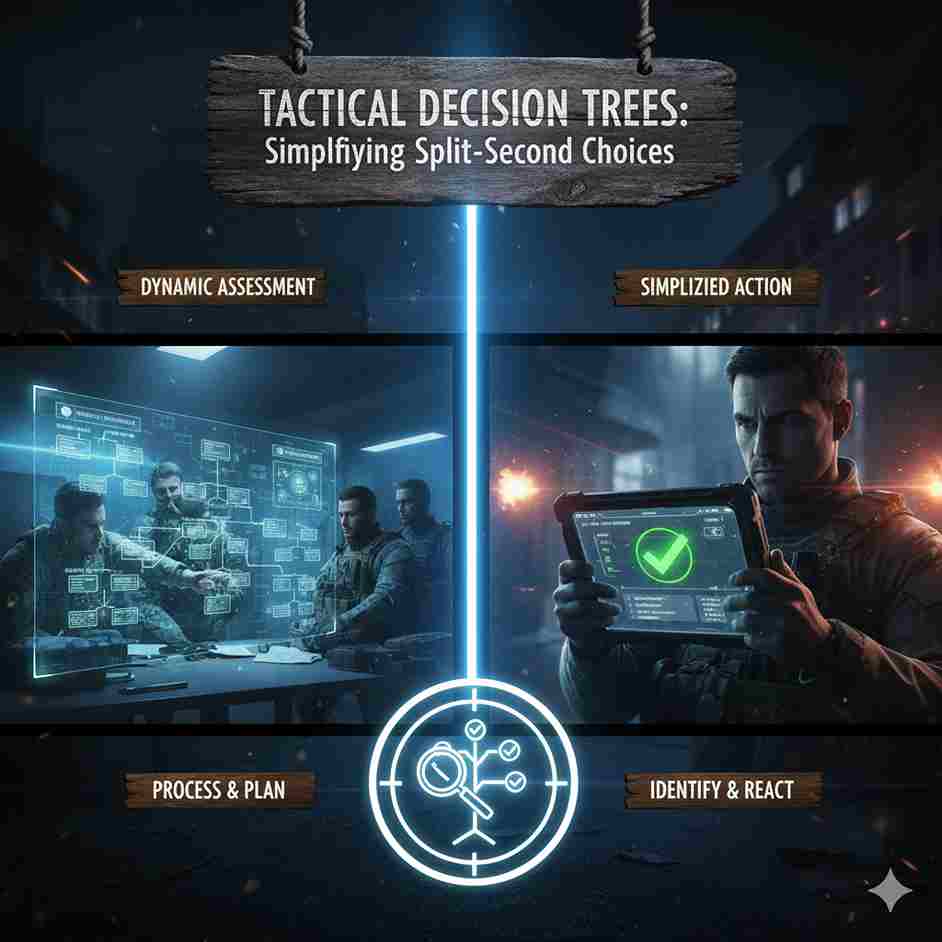
In high-stakes, high-stress environments, a split-second decision can be the difference between mission success and catastrophic failure. The human brain, under extreme pressure, often reverts to primal, reactive thinking. This is where Tactical Decision Trees (TDTs) come into play. A TDT is a simplified, pre-rehearsed mental map that streamlines complex choices into a series of binary (yes/no) steps. It’s a tool that takes the emotion out of the moment, allowing operators to execute the correct procedure on instinct, transforming chaos into a controlled, predictable response.
The Anatomy of a Decision Tree 🧠
A TDT is a flow chart compressed into a mental framework. Its power lies in its simplicity and its reliance on the OODA Loop (Observe, Orient, Decide, Act). The TDT focuses on speeding up the “Orient” and “Decide” phases.
- The Trigger Event (The Initial Condition): This is the starting point—the observable fact that launches the decision process (e.g., “Hearing automatic fire,” “Visual confirmation of a threat,” “Vehicle stalls”).
- The Binary Questions (The Branches): These are simple, diagnostic questions that eliminate options (e.g., “Can I see the target?” “Is the vehicle still running?”).
- The Immediate Action (The Leaf): This is the final, pre-determined, and practiced response (e.g., “Return suppressive fire and maneuver,” “Establish 360-degree security,” “Execute Immediate Action Drill”).
The TDT works because it bypasses the need for creative, slow thought and replaces it with a validated, practiced routine.
TDT in Action: The “Contact Front” Example 🔥
Consider a patrol that suddenly takes enemy fire from the front. A well-rehearsed TDT minimizes the thought process:
| Trigger: | TAKING FIRE (CONTACT FRONT) |
| Question 1: | Can I identify the source of the fire? |
| Branch A (YES): | Go to Question 2. |
| Branch B (NO): | Immediate Action: Lay down suppressive fire in the most likely direction, then seek immediate hard cover. (Focus on survival and location). |
| Question 2: | Am I pinned down/taking casualties? |
| Branch A (YES): | Immediate Action: Break contact (deploy smoke, maneuver laterally, and fight through the danger zone). |
| Branch B (NO): | Immediate Action: Assault the position (return fire, close the distance, neutralize the threat). |
Export to Sheets
This simplified structure ensures that every team member, regardless of their position or stress level, follows the same, correct protocol.
The Secret Sauce: Repetition and Validation
A TDT is worthless if it’s not internalized. The effectiveness of this tool relies on:
- Muscle Memory: The decision pathways must be drilled repeatedly during training (simulations, dry runs) until the response becomes an automatic reflex. The TDT is not read; it’s executed.
- Validation: Every TDT must be validated against real-world scenarios and doctrine. It must be the best possible solution for that specific problem.
- Adaptability: While the core TDT is rigid, the operator must be trained to recognize when the environment (e.g., “The area is civilian-dense, Assault is not an option”) forces them to move to a modified or alternate TDT.
By externalizing the decision process and simplifying complex threats into a series of black-and-white choices, Tactical Decision Trees ensure that the most important resource in combat—the mind—remains clear, focused, and decisive.